The process
From tech pack to delivery: how a private label suit order runs
A private label suit order runs in three stages: you send a tech pack, you approve a sample, and the factory produces. At Hajjo Apparel the sample follows within three weeks and production takes one to three months. In production every garment passes six steps (pattern, cloth, fusing, sewing, pressing and packing), each with its own check.
What is a tech pack?
A tech pack is the written specification of a garment: everything a factory needs to make it the same way every time, without guessing. It is the reference the sample is judged against, and the reference every check in production goes back to.
Hajjo Apparel asks for seven things in a tech pack.
| What to send | What it should say |
|---|---|
| Measurements | The finished measurements of the garment at each point of measure, with the tolerance you accept |
| Size chart | Every size you want, and how the measurements change from size to size |
| Cloth | The mill and article if you have chosen one, or the weight, composition and colour you are after |
| Construction | Fused, half canvas or full canvas |
| Quantities per size | How many pieces of each size, per design |
| Labels | Your main label, size and care labels, and where each is placed |
| Delivery date | When you need the goods |
If you have a pattern, send it. If you do not, the factory takes yours or helps you make one. If you have not chosen a cloth, the factory can source it: it has access to every cloth Nile Wool carries, and more.
Details are yours to decide. Buttons, adjusters and every other detail can be changed, sampled and tested to the tech pack.
How does sampling work?
From the tech pack, the factory makes a sample: one garment in your specification, in the construction you mean to produce. At Hajjo Apparel it follows within three weeks.
The sample is your one chance to change the garment cheaply, so judge it carefully:
- Fit. Try it on a person of the base size, not only on a hanger.
- Measurements. Measure it against your size chart, point by point.
- Cloth. Check the colour in daylight and the handle against what you asked for.
- Construction. Check the chest and the lapel roll you expect from the construction you chose.
- Details and labels. Buttons, pockets, linings, and each label in its place.
Approve in writing, and list any changes in the tech pack itself, so that the specification the factory produces from is the one you signed.
What are the six production steps?
Once the sample is approved, the order goes into production. At Hajjo Apparel it runs in six steps, and each step has its own check, so that a fault is found where it is made.
| Step | What happens | The check |
|---|---|---|
| 1. Pattern | Your pattern is taken, or one is made with you | Checked against the tech pack |
| 2. Cloth | The cloth is chosen and cut | Checked for shade |
| 3. Fusing | The fusing is prepared | Tested on every batch |
| 4. Sewing | The garment is sewn | Seams checked at each operation |
| 5. Pressing | The garment is pressed into shape | Shape checked on the form |
| 6. Packing | A final check, then packed and shipped | Every garment measured before packing |
1. Pattern
The pattern is the garment in flat pieces, graded across every size in your size chart. Before any cloth is cut it is checked against the tech pack, because a mistake in the pattern repeats in every piece that follows. In the cutting room at Obour, a digitizer takes patterns in and a plotter draws them out.
2. Cloth
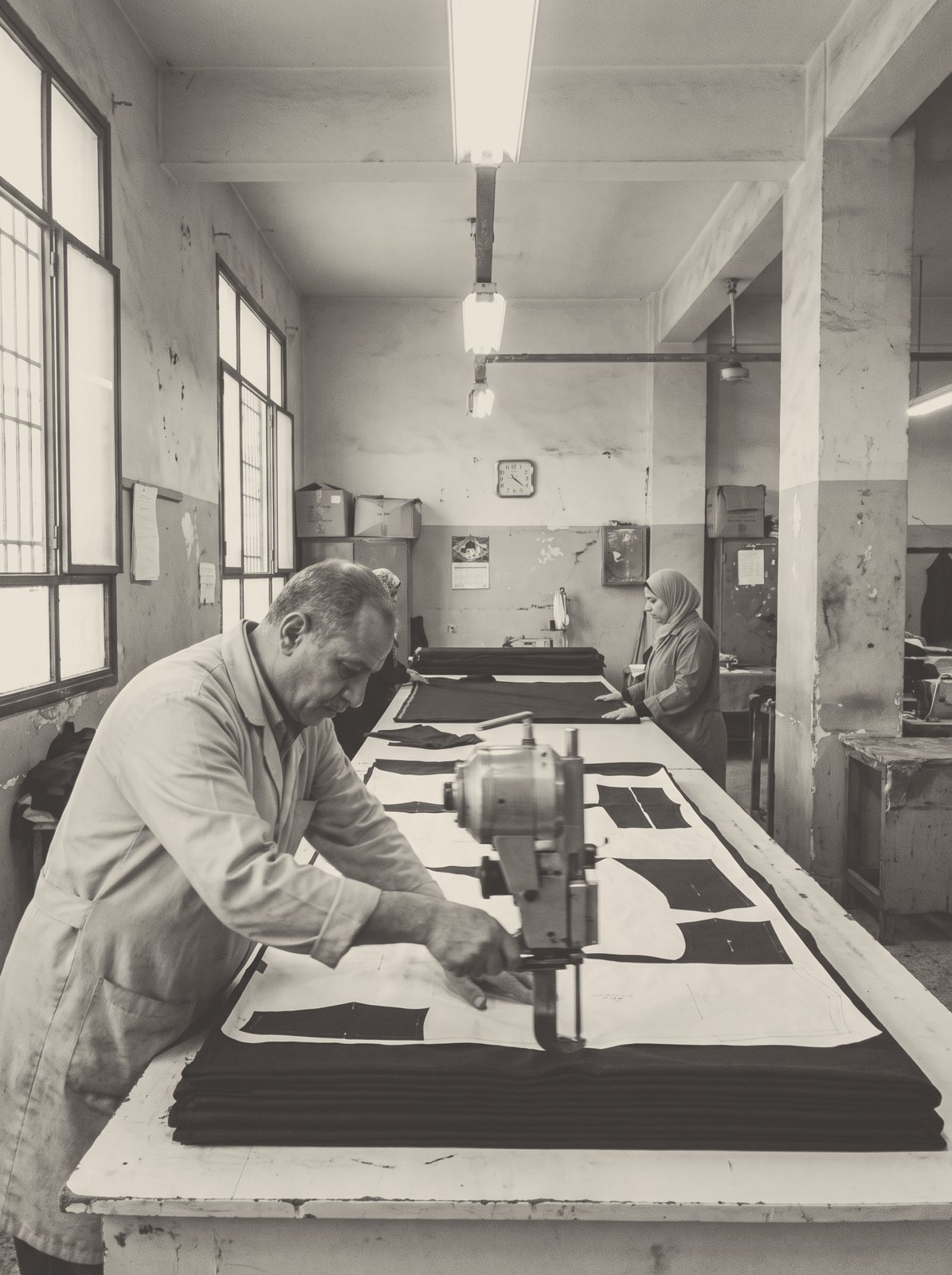
The cloth is chosen and cut. Before cutting it is checked for shade, because two rolls of the same article can differ slightly in colour, and panels cut from different rolls must never meet in one garment.
3. Fusing
Most factory made jackets have fused parts, even canvassed ones, and the bond between fusible and cloth depends on heat, pressure and time. The fusing is tested on every batch, so that a bond that would fail later is caught before sewing. At Obour, fusing runs on a Veit Fuse Master continuous fusing press. The choice between fused, half canvas and full canvas is explained in Fused, half canvas or full canvas: how a suit jacket is built.
4. Sewing
A jacket is sewn in many separate operations, and the seams are checked at each one rather than at the end. At Obour, the specialist operations run on Dürkopp Adler sleeve setting, sleeve support, welt pocket and eyelet buttonhole machines, an AMF Reece eyelet buttonholer and a Pfaff front edge machine, alongside Juki lockstitch lines.
5. Pressing
Pressing is where a tailored garment takes its final shape. At Obour, sleeves are pressed on Rotondi Cavadore sleeve presses, and every garment goes through final pressing. After pressing, the shape is checked on the form.
6. Packing
Before anything is packed, every garment is measured. It is then packed and shipped.
How long does production take?
At Hajjo Apparel, production takes one to three months, depending on the capacity free when the order is placed. Free capacity across the two plants, Obour City in Cairo and Homs, is 5,000 suits a month, or about 7,000 blazers as the equivalent.
To plan a delivery date, add the stages together: up to three weeks for the sample, the time you take to approve it, one to three months of production, and the time in transit to you. A second sample, if the first needs changes, adds to the total. Put the date you need in the tech pack, so the factory can tell you from the start whether it can be met.
Where is the order made?
It depends on the construction. Homs builds fused, half canvas and full canvas; Obour City in Cairo builds fused. Both plants work to the same specification. Orders are invoiced in Egyptian pounds, euros or dollars.
What if the order is small?
Production at Hajjo Apparel starts at 200 pieces a design, in your own label. For smaller quantities, the Group sells finished suits by the series through Bolmandi, and cloth from two metres through Nile Wool. What minimum order quantity means for a suit order compares the three, and How to choose a suit manufacturer in Egypt lists the questions to ask before you send a tech pack anywhere.
Hajjo Apparel and Manufacturing
Send your tech pack
Send your tech pack, quantities per design and target delivery date through the inquiry form on the Hajjo Apparel page, or write to [email protected].